Cell density
Fewer, larger cells (25 per square inch) keep pressure drop lowest. More cells (100 or 200) put more carbon surface in the same volume.
Honeycomb carbon is coal-based activated carbon pressed into blocks with straight channels. Air passes through the channels with little resistance, so the blocks suit large air volumes carrying low concentrations of organic vapour.
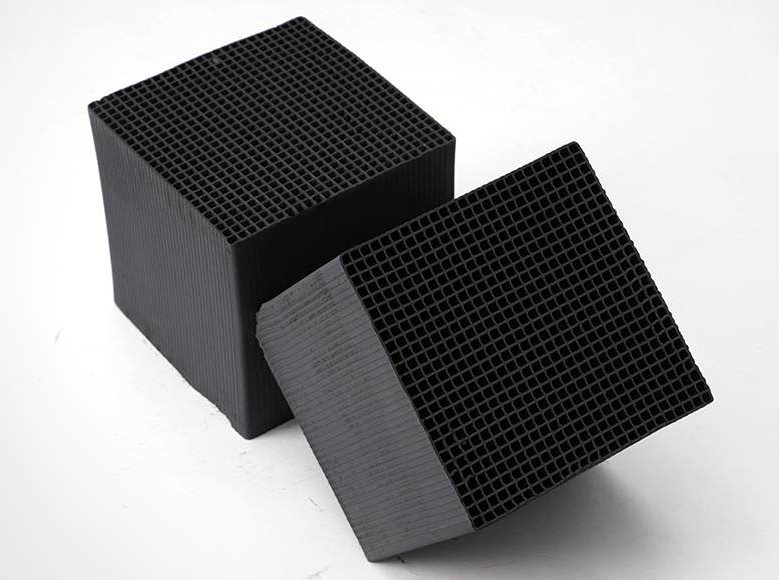
Grade codes are Sandi Carbon's own. Final values are confirmed on the Certificate of Analysis for each batch; custom specifications on request.
| Grade | Cell densityper in² | Iodine numbermg/g | CTC% | Benzene adsorption% | Ash% | Compressive strengthMPa |
|---|---|---|---|---|---|---|
| SC-H25 | 25 | 200–1000 | 20–80 | ≥25 | 3–8 | 0.9 |
| SC-H100 | 100 | 200–1000 | 20–80 | ≥25 | 3–8 | 0.9 |
| SC-H200 | 200 | 200–1000 | 20–80 | ≥25 | 3–8 | 0.9 |
Typical values. Final values are confirmed on the Certificate of Analysis (COA) for each batch. Custom specifications on request. The same values apply to all three cell densities.
"—" means the value is not specified for that grade.
Fewer, larger cells (25 per square inch) keep pressure drop lowest. More cells (100 or 200) put more carbon surface in the same volume.
Standard blocks are 100×100×100, 50×100×100, 50×50×100 and 50×50×50 mm. Send your frame size and we quote blocks to fit, custom sizes included.
Ordinary blocks for dry, high-volume exhaust with low VOC levels. Waterproof blocks for humid exhaust, solvent recovery and some wastewater uses.